
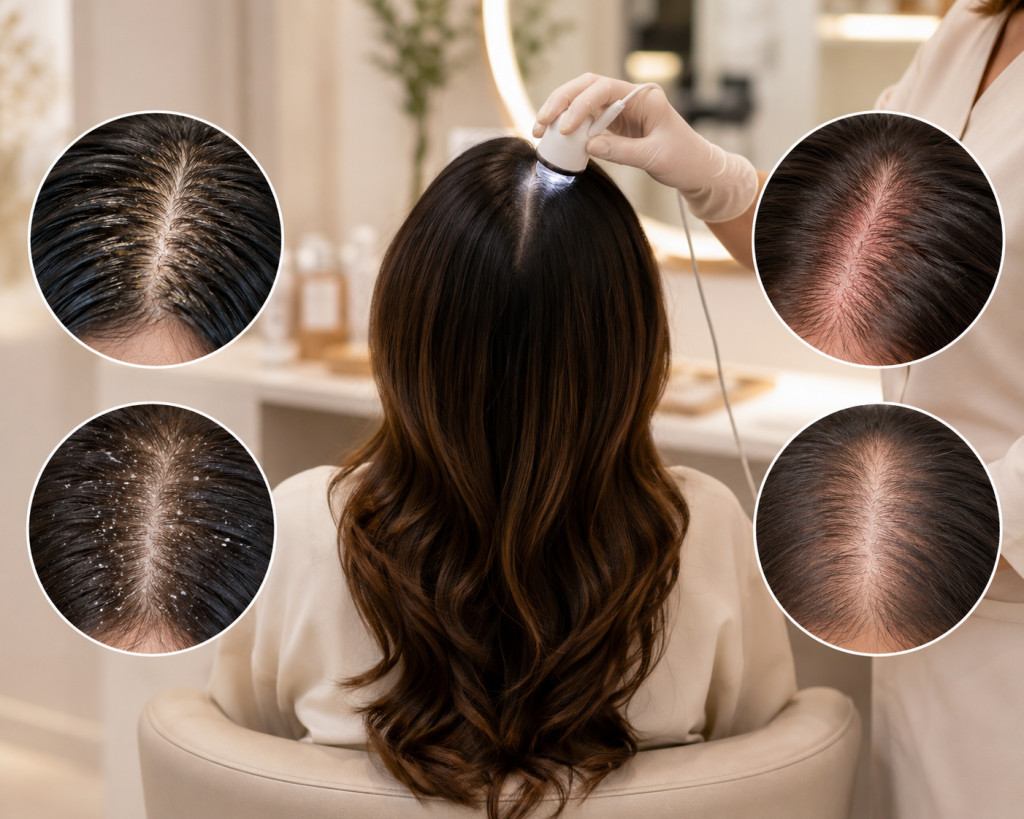
How often you should do a scalp treatment depends on your scalp condition — not on a fixed schedule. An oily scalp with heavy buildup may need more frequent care in the beginning, while a dry or sensitive scalp usually benefits from gentler, less frequent treatment. A thinning scalp is a different case again, because the priority is identifying what is contributing to the thinning rather than simply doing more treatments.
The first step is knowing what type of scalp you actually have. Below is a breakdown by scalp condition, what each one needs, and how to tell when you are treating too often — or not enough.
How Often Does Each Scalp Type Need Treatment?
| Scalp condition | Main concern | Professional treatment approach |
|---|---|---|
| Oily scalp | Excess oil, buildup, greasy roots | May need more frequent care at first, then spaced out |
| Dry scalp | Tightness, dryness, fine flakes | Hydration and barrier support; avoid over-treating |
| Sensitive scalp | Redness, discomfort, itching | Gentle treatment chosen by tolerance, not frequency |
| Dandruff-prone scalp | Flaking, itching, recurring buildup | Depends on the cause and severity |
| Thinning scalp | Reduced density or shedding | Assessment first; scalp treatment alone may not address the cause |
| Normal scalp | Maintenance | Occasional maintenance is usually enough |
Scalp Treatment Is Not the Same as Washing Your Hair
A lot of confusion about frequency comes from mixing up three different things:
- Regular home cleansing. Normal shampooing and scalp cleansing as part of your everyday routine.
- Professional scalp treatment. A deeper salon treatment selected according to the condition of your scalp.
- Medical treatment. Care for a diagnosed scalp condition, which may require assessment or treatment by a healthcare professional.
These operate on completely different schedules. A professional scalp treatment might happen once every few weeks — that does not mean you should only clean your scalp once every few weeks. Regular washing continues as normal, or even more often in Malaysia’s climate.
How Often Should You Treat an Oily Scalp?
An oily scalp may need more frequent care than a normal or dry scalp, especially when excess sebum, sweat and product buildup are present. However, treating it too aggressively can also irritate the scalp, so more is not automatically better.
Signs your scalp leans oily:
- Roots become greasy quickly, sometimes within a day
- Scalp feels oily again soon after washing
- Visible buildup at the roots
- Itchiness
- Noticeable scalp odour
- Oily, yellowish flakes rather than dry white ones
Oily does not automatically mean dirty. Oil production is influenced by your skin type, hair habits, hormones, lifestyle and underlying scalp conditions. Someone who washes daily can still have a congested scalp.
Can too much scalp treatment make an oily scalp worse?
It can. Harsh or unsuitable treatment strips the scalp, and an irritated scalp does not necessarily produce less oil. This is why we usually start with a more supportive schedule to clear buildup and then space treatments out, rather than treating aggressively indefinitely. If oiliness and flaking are your main issue, our guide to oily scalp and dandruff treatment in KL and PJ goes deeper.
[IMAGE SLOT 1 — replace this line with the photo]
Filename: kimarie-oily-scalp-scan-malaysia.jpg
Alt text: Oily scalp scan showing sebum buildup at Kimarie Salon Malaysia
Caption: Scalp scan showing excess sebum and buildup around the follicle openings.
How Often Should You Treat a Dry Scalp?
Dry scalps generally need gentler care rather than aggressive or overly frequent deep cleansing. The goal is restoring comfort and barrier support, not stripping away more.
Signs your scalp leans dry:
- Tight feeling, especially after washing
- Fine, dry, powdery flakes
- Dull-looking scalp
- Discomfort after shampooing
- Dryness without heavy oil buildup
Dry scalp vs dandruff
Dry-looking flakes do not automatically mean dandruff. The two can look similar but often need different approaches: a dry scalp is usually about moisture and barrier support, while dandruff typically involves other factors and may need a different type of care. Treating dandruff products on a simply dry scalp can make the dryness worse.
How Often Should You Treat a Sensitive Scalp?
With a sensitive scalp, the priority is choosing the right treatment — not increasing how often you treat it.
Possible signs include redness, itching, a scalp that reacts easily, burning or stinging with certain products, discomfort after colouring, and frequent reactions to new products.
Should a sensitive scalp be detoxed frequently?
Not necessarily. Aggressive exfoliation or repeated deep cleansing is not automatically better for sensitive skin, and in some cases it prolongs the irritation. This is exactly why a scalp assessment should come before selecting any treatment, so the product and intensity are matched to what your scalp can tolerate.
How Often Should You Do Scalp Treatment for Dandruff?
Treatment frequency for dandruff depends on what is causing the flaking and which treatment is being used. Professional salon scalp care should not be presented as a replacement for medical treatment when a scalp condition requires it.
For mild buildup or occasional flakes, a sensible sequence is a scalp assessment, appropriate cleansing and care, then monitoring how the scalp responds over the next few weeks.
For persistent or severe symptoms, a medical assessment is the right next step — particularly with severe flaking, significant inflammation, sores, pain, or symptoms that continue despite appropriate care.
How Often Should You Do Scalp Treatment for Thinning Hair?
If your hair is thinning, frequency is not the first question to ask. The first question is why your hair is thinning.
More scalp treatments do not automatically mean more hair growth. Thinning can be driven by genetics, hormones, postpartum changes, stress, nutrition, medication or scalp conditions, and those causes respond differently.
A more useful sequence looks like this:
- Examine the scalp properly
- Understand the thinning or shedding pattern
- Check scalp and follicle condition
- Identify suitable treatment options
- Monitor progress over time
Can scalp treatment help hair grow?
Scalp care can help maintain a clean, healthy scalp environment, which supports the hair growing there. But not every type of hair thinning can be corrected with scalp treatment alone. Where thinning is the main concern, Kimarie offers CEP hair loss treatment and, for those wanting an immediate cosmetic result, Nano Hair Restoration — but which one suits you, if either, follows the assessment rather than preceding it.
[IMAGE SLOT 2 — replace this line with the photo]
Filename: kimarie-scalp-density-comparison-malaysia.jpg
Alt text: Scalp density comparison before and after treatment at Kimarie Salon Malaysia
Caption: Density comparison recorded during scalp monitoring at Kimarie.
Does Malaysia’s Hot and Humid Weather Affect Your Scalp?
Malaysia’s hot and humid climate can influence how quickly the scalp feels oily or congested, which is why scalp-care routines here may need to differ from those used in cooler or drier climates.
In practice, the climate contributes to more sweating, faster-greasing roots, sebum and product buildup, and general scalp discomfort — which is also why many people here wash more frequently than they would elsewhere. That is not a problem in itself. What matters is whether the cleansing you are doing suits your scalp condition.
Signs You May Be Doing Scalp Treatment Too Often
More frequent treatment does not necessarily mean a healthier scalp. Watch for increased sensitivity, tightness, new dryness, irritation, redness, or discomfort that appears after treatment rather than before it. If your scalp felt better before you started treating it more often, that is worth raising at your next visit.
Signs Your Scalp May Need More Attention
On the other side, these suggest your current routine is not keeping up: excessive oil buildup, recurring flakes, persistent itchiness, noticeable scalp odour despite washing, ongoing sensitivity, unusual shedding, or visible thinning.
Persistent or severe symptoms should be professionally assessed rather than repeatedly self-treated.
What Happens During a Professional Scalp Treatment at Kimarie?
Our approach is the same regardless of which treatment you end up having: Scan → Identify → Treat → Monitor.
Step 1 — Scalp analysis
We look at oil level, dryness, buildup, flakes, redness, follicle obstruction, hair root condition and — where relevant — hair density. Our scalp consultation uses a three-mode analysis: a surface mode checking oil and blockage, an inflammation mode identifying redness, and a UV microbiome mode assessing the follicle environment.
Step 2 — Choose the appropriate treatment
Not one treatment for everyone. What the scalp actually needs decides the treatment — for many clients that is the Yululuka scalp treatment by No3 Japan, a plant-derived system formulated with Asian hair and scalp characteristics in mind.
Step 3 — Professional scalp cleansing and care
The treatment itself combines cleansing, product application and scalp massage, adjusted to your tolerance and condition rather than run as a fixed protocol.
Step 4 — Recheck the scalp
We look again after treatment, so the difference is observed rather than assumed.
Step 5 — Recommend a maintenance frequency
Your next treatment should be scheduled based on how your scalp responds — not simply because a fixed number of days has passed.
[IMAGE SLOT 3 — replace this line with the photo]
Filename: kimarie-stylist-scalp-analysis-malaysia.jpg
Alt text: Kimarie stylist performing a professional scalp analysis in Malaysia
Caption: Every scalp treatment at Kimarie starts with an analysis, not an assumption.
What’s Your Scalp Type?
- Greasy quickly after washing? → Possibly oily scalp
- Tight with small dry flakes? → Possibly dry scalp
- Red, itchy or easily irritated? → Possibly sensitive scalp
- Oily roots with yellowish flakes? → Possibly congested or dandruff-prone scalp
- Parting getting wider or density reducing? → Thinning — assess first
These are general signs and are not a medical diagnosis.
When Should You See a Dermatologist Instead?
Professional salon scalp care can support scalp maintenance, but some scalp and hair-loss conditions require medical assessment. See a doctor or dermatologist if you have severe redness or inflammation, open sores, bleeding, a painful scalp, sudden or patchy hair loss, persistent dandruff despite appropriate care, or symptoms that continue or worsen.
Kimarie Scalp Expert Tip
Don’t treat the symptom before understanding the scalp.
Someone with an oily, flaky scalp may need a completely different approach from someone with dry flakes — even though both clients will usually describe the problem as “dandruff.” That is why we scan first.
Scalp Treatment FAQs
How often should you do scalp treatment?
It depends on your scalp condition. Oily or congested scalps often need more frequent care initially, while dry and sensitive scalps generally do better with gentler, less frequent treatment. The most reliable answer comes from a scalp assessment and from watching how your scalp responds to the first few treatments.
Can I do scalp treatment every week?
Weekly professional treatment is more than most scalps need and can be too much for dry or sensitive skin. It is sometimes appropriate for a short period when clearing significant buildup, but it should be a deliberate short-term plan rather than an indefinite routine.
Is monthly scalp treatment enough?
For many people with a reasonably healthy scalp, monthly or less frequent maintenance is enough. If flakes, itchiness or oiliness keep returning well before the next appointment, that is a sign the interval or the treatment itself needs adjusting.
How often should an oily scalp be treated?
Oily scalps usually need more frequent care than dry ones, particularly while buildup is being cleared. After that, treatments are typically spaced out. Over-treating an oily scalp can irritate it, so frequency should be reduced as the scalp settles.
Does dry scalp need scalp treatment?
It can benefit, but the treatment should focus on hydration and barrier support rather than deep cleansing or exfoliation. A dry scalp treated with strong clarifying products often ends up tighter and more uncomfortable than before.
Is scalp treatment good for dandruff?
Professional scalp care can help with mild buildup and flaking, but it depends on the cause. Persistent or severe dandruff, especially with inflammation or pain, should be assessed medically rather than managed with salon treatments alone.
Can scalp treatment help hair loss?
Scalp care supports a healthier environment for hair to grow in, but it does not address every cause of hair loss. Thinning driven by genetics, hormones or medical factors needs to be identified first — which is why we assess before recommending anything.
Is scalp treatment suitable for a sensitive scalp?
Often yes, provided the treatment is chosen for tolerance rather than intensity. Sensitive scalps need gentler products and less aggressive technique, and the frequency should be conservative until you know how your scalp reacts.
How do I know what scalp type I have?
The everyday signs — how quickly your roots grease up, whether flakes are dry or oily, whether your scalp feels tight or itchy — give you a reasonable idea. A professional scalp scan gives a clearer picture, including follicle condition and buildup you cannot see yourself.
Should I wash my hair before a scalp treatment?
You do not need to. Arriving with your scalp in its normal state actually helps, because it lets us see your usual oil level and buildup rather than a freshly washed version of it.
Not Sure About Your Scalp Type? Start With an Assessment
At Kimarie, we assess your scalp condition before recommending the appropriate treatment and maintenance schedule. You do not need to know your scalp type before coming in — that is what the scan is for.
Kimarie has been hairdressing in Malaysia since 1982, with salons in SS2 Petaling Jaya, Kota Damansara, IOI Boulevard Puchong, Taipan USJ Subang Jaya and Sri Petaling.
Book a Scalp AnalysisExplore Scalp TreatmentsFind a Kimarie Salon Near You