
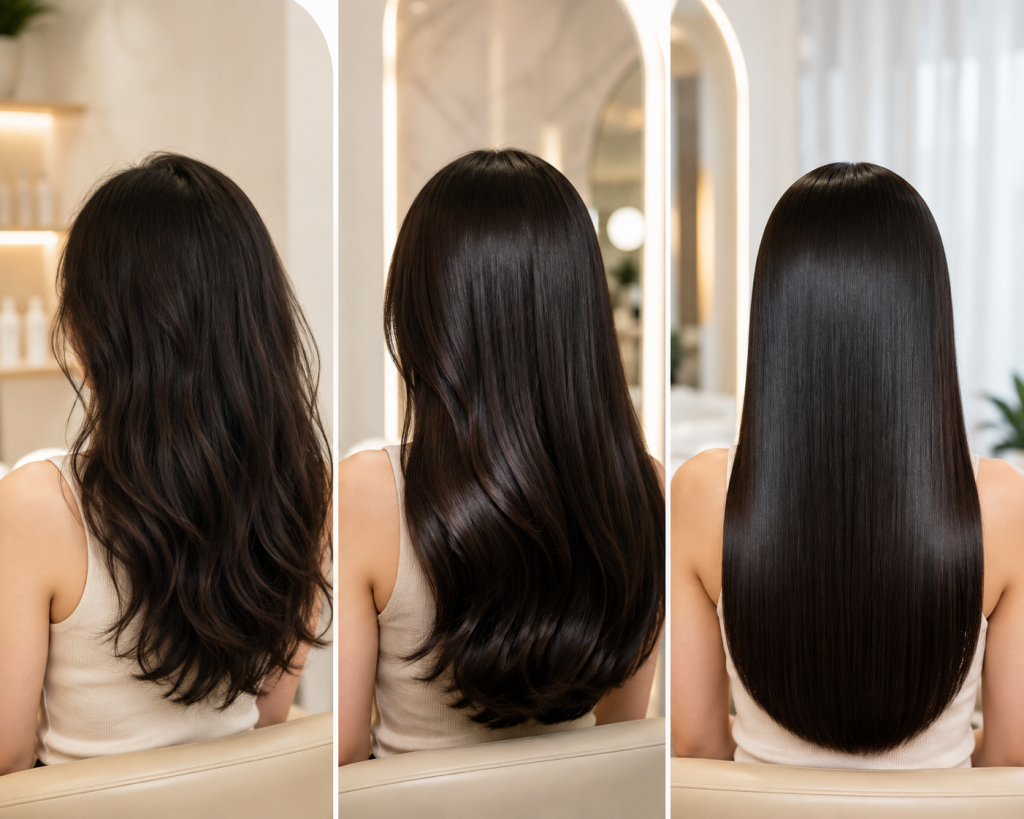
There is no single “best” hair smoothing treatment. The right choice depends on the result you actually want. Anti-Frizz is for reducing frizz while keeping your hair’s natural movement. Keratin is for smoother, softer, more manageable hair. Rebonding is for maximum straightness. At Kimarie, we recommend choosing based on your hair condition and desired result — not simply choosing the strongest treatment.
Below is a side-by-side comparison of all three, followed by what each treatment does, who it suits, and the questions worth asking before you book.
Anti-Frizz vs Keratin vs Rebonding at a Glance
| Feature | Anti-Frizz | Keratin | Rebonding |
|---|---|---|---|
| Main purpose | Control frizz | Smooth & soften | Straighten |
| Straightening effect | ★★★☆☆ | ★★☆☆☆ | ★★★★★ |
| Gentleness | ★★★★☆ | ★★★★☆ | ★★☆☆☆ |
| Natural movement | High | High | Lower |
| Best for | Frizzy, puffy hair | Dry, frizzy, hard-to-manage hair | Curly or wavy hair wanting straight results |
| Finish | Natural & controlled | Smooth & soft | Straight |
| Typical duration | Around 2–3 months | Around 4 months | Grows out — regrowth becomes visible |
| Commitment | Lower | Lower | Higher |
What Is Anti-Frizz Treatment?
Anti-Frizz treatment is a smoothing service designed to calm frizz and puffiness while leaving your hair’s natural body and movement intact. It is the option most people are actually looking for when they say “my hair is unmanageable” rather than “I want poker-straight hair.”
It targets four everyday problems:
- Frizz, especially on the surface and around the hairline
- Puffiness and excessive volume
- Rough, dry-feeling texture
- Hair that takes too long to style each morning
Does Anti-Frizz make your hair completely straight?
Not necessarily. Anti-Frizz is designed primarily to control frizz and improve manageability rather than create the very straight result associated with rebonding. Hair usually looks smoother and sits flatter, but it keeps movement and can still be curled or styled.
The Anti-Frizz treatment we use at Kimarie
Kimarie uses Anti-Frizz Treatment Zero from Japan, which works with bio-active pure cysteamine to smooth each strand from within rather than forcing it flat. The formula is free from ammonia, silicone and formaldehyde. In our salons, results typically last around 2 to 3 months, depending on hair condition, how often you wash and what you use at home.
It suits frizzy, wavy, coarse or thick unruly hair — the kind of hair that behaves indoors and expands the moment you step outside.
[IMAGE SLOT 1 — replace this line with the photo]
Filename: kimarie-anti-frizz-treatment-before-after.jpg
Alt text: Before and after Anti-Frizz hair treatment at Kimarie Salon Malaysia
Caption: Kimarie Anti-Frizz treatment — actual salon result
What Is Keratin Treatment?
Keratin treatment is a smoothing service focused on how hair feels and behaves. The goal is softer, silkier hair that dries faster, blow-dries more easily and stays smooth for longer between washes.
People generally choose keratin for:
- A smoother, glossier surface
- A noticeably softer feel
- Easier, faster blow-drying
- Frizz reduction without losing shape
- Hair that is simply easier to live with
Does keratin make hair straight?
Keratin treatment can make hair look smoother and somewhat straighter, but it is not primarily designed to produce the same pin-straight result as rebonding. If straightness is your main objective, keratin on its own will usually feel like an improvement rather than a transformation.
The keratin system we use at Kimarie
Our Keratin Treatment 3.0 uses Alfaparf Milano Professional’s Lisse Design Keratin Therapy system, built on biomimetic lamination technology that mimics the natural lipid structure of healthy hair. The formula is formaldehyde-free, the service takes roughly two hours including consultation, and results typically last around four months with sulphate-free aftercare.
There is no waiting period afterwards — you can wash, tie and style your hair normally. It is a common choice for clients with colour-treated or slightly dry hair who want smoothness without a flat, over-processed look.
[IMAGE SLOT 2 — replace this line with the photo]
Filename: kimarie-keratin-treatment-before-after.jpg
Alt text: Before and after Keratin Treatment 3.0 at Kimarie Salon Malaysia
Caption: Kimarie Keratin Treatment 3.0 — actual salon result
What Is Hair Rebonding?
Rebonding is for one goal: “I want my hair straight.” Not “I just don’t want frizz.” That distinction is the single most useful thing to be clear about before you book.
Rebonding chemically restructures the hair to create a lasting straight result. Compared with smoothing treatments it involves a stronger structural change, which is why it delivers the most dramatic difference and also why it deserves the most consideration.
- Strongest straightening result of the three
- Especially suited to naturally wavy or curly hair when straightness is the main objective
- The treated section stays straight, so regrowth becomes visible as new hair grows in
- Requires careful assessment on previously bleached, coloured or damaged hair
Is rebonding more damaging than keratin?
Rebonding generally involves a stronger structural change to the hair than smoothing treatments. However, the actual condition of the hair afterwards depends on the hair’s existing condition, previous chemical services, the products used and professional technique. A well-assessed rebond on healthy hair can look better than a poorly judged treatment of any kind.
You can see rebonding alongside our perm and straightening options on the Kimarie services page.
[IMAGE SLOT 3 — replace this line with the photo]
Filename: kimarie-hair-rebonding-before-after.jpg
Alt text: Before and after hair rebonding at Kimarie Salon Malaysia
Caption: Kimarie rebonding — actual salon result
Anti-Frizz vs Keratin vs Rebonding: What’s the Difference?
The simplest way to separate them is by what each one is trying to change.
- Anti-Frizz changes behaviour. Your hair keeps its shape but stops puffing up and fighting you.
- Keratin changes feel and finish. Your hair becomes smoother, softer and faster to style.
- Rebonding changes shape. Curl and wave are replaced with a straight form.
Anti-Frizz and keratin overlap — both reduce frizz — but their formulations, application and resulting finish differ. Rebonding sits in a different category altogether.
Which Treatment Should You Choose?
Choose Anti-Frizz if…
“My hair is frizzy and puffy, but I don’t want it completely straight.”
This is the right fit if your hair is already fairly straight or gently wavy and the real problem is frizz, volume and humidity. You want it to sit properly and behave, not to lose its shape. Anti-Frizz gives you a controlled, natural finish that still lets you tie your hair up, curl it or wear it down without looking flat.
Choose Keratin if…
“I want my hair smoother, softer and easier to manage.”
Choose keratin when the complaint is texture rather than shape — hair that feels rough, looks dull, tangles easily or takes far too long to blow-dry. It is also a common choice for colour-treated hair that has started to feel dry. You get smoothness and shine while keeping natural movement.
Choose Rebonding if…
“My hair is curly or wavy and I want it significantly straighter.”
If you have tried smoothing treatments and still feel your hair is not straight enough, rebonding is the treatment that actually addresses that. Go in understanding that it is a longer-term commitment: the result lasts on the treated hair, and regrowth eventually needs managing. It is worth a proper assessment first if your hair has been bleached or heavily processed.
Which Treatment Is Best for Your Hair Type?
- Frizzy but relatively straight hair → Anti-Frizz
- Dry and frizzy hair → Anti-Frizz or Keratin, depending on whether your priority is control or softness
- Wavy hair → Depends on whether you want smoothing or straightening
- Curly hair, wanting straight hair → Rebonding
- Bleached or heavily damaged hair → Professional hair assessment first
Which Is Best for Malaysia’s Humid Weather?
Humidity makes frizz more visible because moisture in the air swells the hair and lifts the cuticle, which is why hair that looked fine in an air-conditioned room expands within minutes outdoors. That is a surface and behaviour problem, not necessarily a shape problem.
So the honest answer depends on what humidity is doing to your hair:
- If it causes surface frizz and puffiness, a smoothing treatment such as Anti-Frizz usually addresses it directly.
- If it makes your hair rough and hard to style, keratin tends to help most.
- If your hair is naturally curly and you want it straight regardless of the weather, that is a rebonding conversation.
What If Your Hair Is Bleached or Damaged?
Previously bleached or chemically processed hair should be assessed before any smoothing or straightening treatment. There is no reliable rule that says one treatment is always safe for damaged hair — the outcome depends on how much of the hair’s structure is still intact, what was done to it before, and how recently.
In practice that assessment covers your colour and bleach history, any previous rebonding or perming, the current elasticity and porosity of the hair, and the finish you are hoping for. Sometimes the recommendation is a conditioning course first and the smoothing treatment later.
7 Questions to Ask Before Choosing Your Treatment
- Do I want less frizz, or genuinely straighter hair?
- Do I want to keep my natural movement?
- Has my hair been bleached?
- Have I rebonded, permed or coloured it before — and how recently?
- How damaged is my hair right now?
- How much maintenance am I comfortable with?
- What result am I actually expecting to see in the mirror?
Kimarie Stylist Tip
Don’t choose a treatment based only on the name. Two clients with equally frizzy hair may need completely different treatments, because their hair history, texture, damage level and expected result are different.
At Kimarie, we assess your hair condition and desired result before recommending Anti-Frizz, Keratin or Rebonding.
[IMAGE SLOT 4 — replace this line with the photo]
Filename: kimarie-stylist-hair-consultation.jpg
Alt text: Kimarie stylist assessing a client’s hair condition before a smoothing treatment
Caption: Every treatment at Kimarie starts with an assessment, not a price list
Anti-Frizz vs Keratin vs Rebonding FAQ
Is Anti-Frizz the same as Keratin?
No. Both may reduce frizz, but their formulations, treatment approach and resulting finish differ. Anti-Frizz leans towards control and manageability while keeping volume; keratin leans towards smoothness, softness and shine.
Is Keratin the same as Rebonding?
No. Keratin primarily improves smoothness and manageability, while rebonding is intended to create a significantly straighter result by restructuring the hair.
Which lasts longer, keratin or rebonding?
Rebonding lasts longer in the sense that the treated hair stays straight permanently — you see regrowth rather than a fading effect. Keratin is a smoothing treatment that gradually wears off, typically lasting around four months at Kimarie with proper aftercare.
Which treatment is better for damaged hair?
It depends on how the hair was damaged and how much structure remains. Smoothing treatments are generally gentler than rebonding, but “damaged hair” covers a wide range of conditions. An in-salon assessment is the only reliable way to answer this for your hair.
Can I do Anti-Frizz on coloured hair?
In many cases yes, and it is a common request. Because colour and bleach affect the hair’s condition, your stylist should check the hair before treatment and advise on the sequence and timing.
Can I colour my hair after keratin?
Colouring after a smoothing treatment is possible, but the order and spacing of the two services matters. Tell your stylist at the consultation stage if you plan to colour, so the schedule can be planned properly.
Can bleached hair be rebonded?
Not automatically. Bleached hair has already undergone significant structural change, and rebonding adds another. This is exactly the case where a professional assessment comes before any booking, and where the answer is sometimes “not yet.”
Which treatment is best for frizzy hair in Malaysia?
For most people whose main complaint is frizz and puffiness in humid weather, Anti-Frizz is the closest match, because it controls frizz without removing natural movement. If the hair also feels rough and dry, keratin may suit better. If the underlying wish is straight hair, rebonding is the honest answer.
How much do these treatments cost?
Pricing depends on hair length, thickness and condition. Keratin Treatment 3.0 at Kimarie starts from RM480 at the time of writing; for Anti-Frizz and rebonding, please check current pricing with your nearest salon.
Not Sure? Let a Kimarie Stylist Assess Your Hair
You don’t have to decide before visiting us. Let a Kimarie stylist assess your hair condition, chemical history and desired finish before recommending the most suitable option — Anti-Frizz, Keratin Treatment 3.0 or rebonding.
Kimarie has been hairdressing in Malaysia since 1982, with salons in SS2 Petaling Jaya, Kota Damansara, IOI Boulevard Puchong, Taipan USJ Subang Jaya and Sri Petaling.